
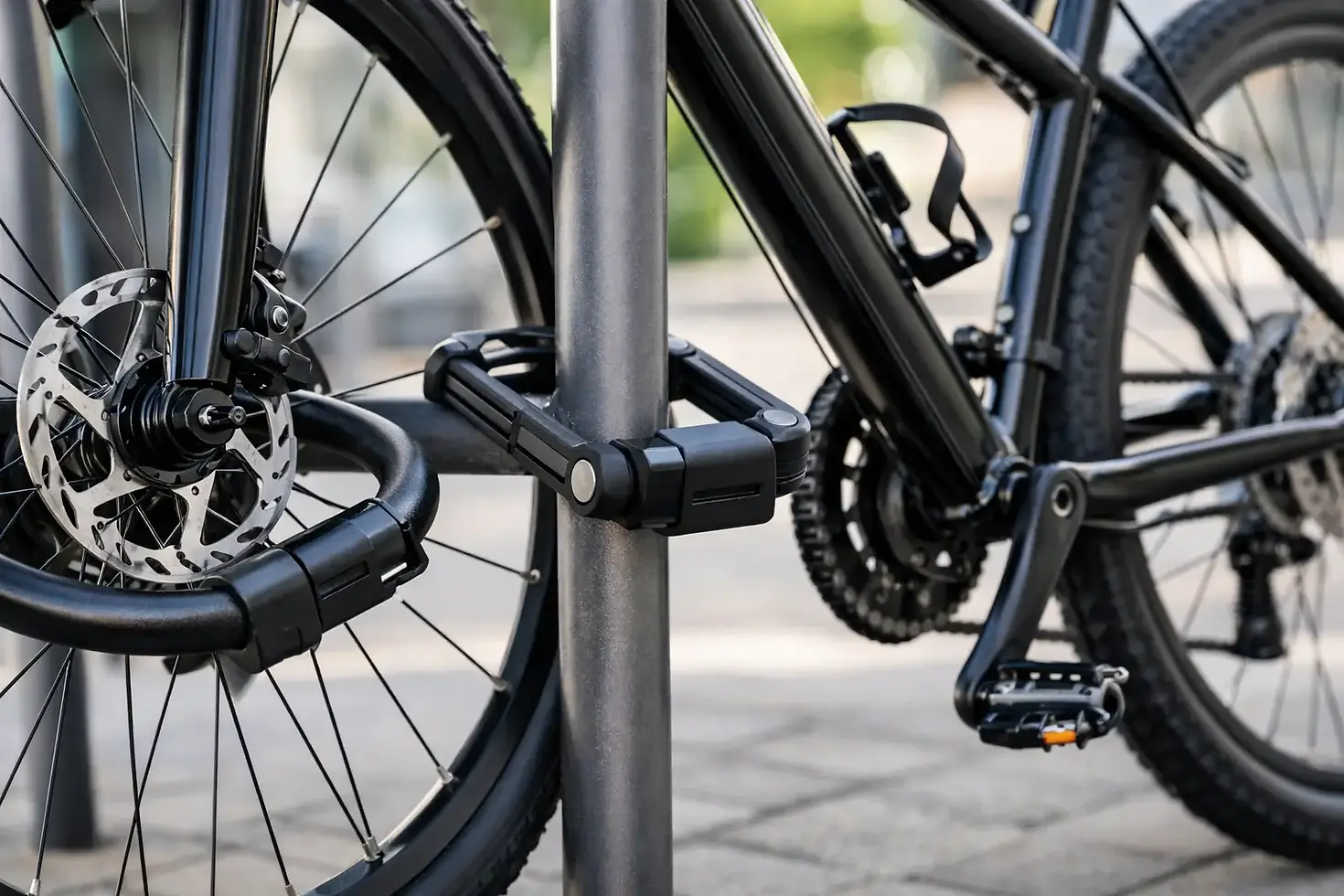
Best Bike Lock for Quick Release Wheels
A quick-release lever saves time right up until someone else uses it. If you park in public, a bike lock for quick release wheels is not a nice extra. It is one of the smartest upgrades you can make, because a thief does not need much time, noise, or skill to remove an unsecured wheel.
That is the problem with relying on a frame lock alone. Your bike may still be attached to the rack while the front wheel is gone. On some bikes, the rear wheel and saddle are just as exposed. If you commute, run errands, or leave your bike outside work, school, or a cafe, component theft is not a rare edge case. It is one of the most predictable forms of bike theft.
Why a bike lock for quick release wheels matters
Quick-release hardware was built for convenience. That convenience is useful when you are loading a bike into a car, fixing a flat, or swapping wheels. It is also useful for thieves. A standard quick-release skewer can be opened by hand in seconds, with no special tools and very little attention.
That changes the risk profile of your bike. A basic U-lock may secure the frame and maybe one wheel if you are careful, but many real-world parking setups do not make that easy. Bike racks vary. Tire widths vary. Fenders, disc brakes, cargo setups, and frame shape can all get in the way. If the wheel is left outside the main lock area, the vulnerability is obvious.
A purpose-built wheel security system closes that gap. Instead of trying to stretch one lock across every theft point, it secures the wheel at the axle so the component itself cannot be quickly removed. That is a much cleaner and more reliable defense.
What makes a good bike lock for quick release wheels
The best option is not the bulkiest one. For wheel security, what matters is whether the system removes the easy opportunity that quick-release hardware creates.
A strong bike lock for quick release wheels should replace the standard quick-release mechanism with a security skewer or axle-based locking solution that cannot be opened by hand. That sounds simple, but the details matter. The fit has to match your bike. The hardware has to hold up to daily riding, weather, and repeated wheel removal for maintenance. And it should not add a lot of weight or hassle to a bike you use often.
Security also needs to be practical. If a system is annoying to use, riders stop using it properly. That is why low-profile, component-specific hardware is often the better answer than carrying extra cables and trying to thread them through every part of the bike.
The right setup usually gives you four things at once: wheel protection, cleaner bike fit, lower weight than multiple secondary locks, and less daily friction when you park.
Security skewers vs traditional locking habits
Many riders assume a frame lock plus careful parking is enough. Sometimes it is. Often it is not. Urban parking is inconsistent, and even experienced cyclists end up locking to imperfect racks, signs, or crowded bike areas where ideal wheel placement is not possible.
Security skewers solve a different problem than a U-lock. A U-lock protects where the bike is attached. A wheel lock system protects what can be removed from the bike itself. Those jobs overlap a little, but they are not the same.
That distinction matters because theft is often opportunistic. If a thief sees a frame secured with a missing wheel opportunity, they do not need to take the whole bike to cause a costly loss.
The limits of cables and improvised fixes
A lot of riders try to compensate with a cable through the front wheel. It is better than nothing, but it is still a compromise. Cables are often lighter duty, easier to cut, awkward to carry, and easy to skip when you are making a quick stop.
They also do not address the bigger pattern. If your wheel is quick release, there is a good chance your seat post or saddle is equally easy to remove. Now you are managing multiple weak points with add-on fixes instead of using a system designed for the actual theft risks.
That is where component-level security stands out. It treats removable parts as the target, not as an afterthought.
Choosing the right wheel security setup
Not every bike needs the exact same solution. The right choice depends on how you ride, where you park, and how your bike is built.
If you lock up daily in busy public areas, wheel security should be treated as standard equipment. If your bike has high-value wheels, disc brakes, or commuter gear that makes replacement expensive and inconvenient, the case gets even stronger. If you mostly store your bike indoors and rarely leave it unattended, your risk is lower, but quick-release hardware is still an open invitation during occasional stops.
You also need to think beyond the front wheel. Riders often focus there first because it is the easiest target, but rear wheels, saddles, and seat posts are frequently stolen too. The smartest approach is to protect the parts a thief can remove fastest.
A better fit for commuters and everyday riders
Commuters usually feel the pain of component theft more than anyone else. Losing a wheel is not just a repair bill. It can mean missing work, scrambling for transportation, and spending time sourcing compatible parts.
That is why a dedicated system makes more sense than a patchwork of accessories. A properly fitted security skewer for each vulnerable component gives you a more complete defense without turning every parking stop into a routine of extra cables and guesswork.
Pinhead Bike Locks built its reputation around exactly this problem: protecting the whole bike, not just the frame. That matters because most theft prevention advice still starts and ends with one primary lock, while experienced riders know that removable parts are often the easier target.
Installation and daily use
One reason riders put off wheel security is the assumption that it will be difficult to install or annoying to live with. In most cases, it is neither. Once the original quick-release hardware is replaced with the correct security hardware, the protection is always on the bike. You are not relying on memory or carrying one more item in your bag.
That built-in aspect is a major advantage. Security works better when it is part of the bike, not dependent on whether you remembered a second lock on a rushed morning.
There is a trade-off, of course. If you remove your wheels often for transport or race-day setup, you need a system that balances security with manageable service access. That does not mean abandoning protection. It means choosing hardware designed for your bike and your maintenance habits.
Common mistakes when securing quick-release wheels
The biggest mistake is assuming the main lock covers everything. It usually does not. A thief does not care that your frame is secure if the front wheel can be gone in ten seconds.
The second mistake is protecting only one vulnerable part. A secured front wheel with an unsecured saddle or seat post still leaves you exposed. Theft follows the easiest path.
The third mistake is waiting until after a loss. Quick-release theft is one of the easier bike crimes to prevent because the vulnerability is mechanical and obvious. Once you replace the exposed hardware, you remove the fastest opportunity.
When is a bike lock for quick release wheels worth it?
If your bike ever spends time unattended in public, it is worth serious consideration. The more expensive the wheelset, the more often you park, and the more frequently you leave the bike in predictable locations, the stronger the case becomes.
It is also worth it for riders who want a lighter, cleaner security strategy. Carrying multiple bulky locks is not the only answer. A component-specific system lets your main lock do its job while the vulnerable parts protect themselves.
That is the real value here. A bike lock for quick release wheels does not replace smart locking habits. It fixes a weakness those habits often leave behind.
The best security upgrades are the ones that remove easy opportunities before someone takes advantage of them. If your wheels still come off with a hand-operated lever, that opportunity is still there. Change the hardware, protect the parts that get stolen first, and give your bike fewer weak points the next time you lock up.


Comments