


How to Protect Bike Parts in City Parking
- Dylan Row
- Jul 9
- 6 min read
A locked frame beside a coffee shop rack can still lose a front wheel, saddle, or seat post before the person behind you gets their drink. That is the real problem with trying to protect bike parts in city parking - most theft is fast, targeted, and focused on whatever can be removed in seconds with a lever, basic tool, or a little practice.
A standard frame lockup only solves one theft vector. It does not stop someone from pulling a quick-release skewer, sliding out a saddle, removing a stem cap, or stripping parts from a bike left in the same place every workday. If your bike has higher-end wheels, a carbon seat post, an expensive saddle, or commuter accessories with resale value, the weak point is rarely the U-lock. It is the unsecured component.
Why city parking exposes the small parts first
Most urban bike theft is opportunistic, but that does not mean random. Thieves go after the fastest payout with the lowest risk. A complete bike takes time, leverage, and attention. A wheel or saddle takes a few seconds and can disappear into a backpack.
Quick-release hardware made bikes convenient for owners and equally convenient for thieves. Front wheels are a common target because they are easy to remove and easy to resell. Saddles and seat posts are next because many riders leave them completely unsecured. On some bikes, headset spacers, stems, and even accessories are soft targets if they can be removed with a basic hex key.
That is why component-level security matters. You are not only trying to stop a full bike theft. You are trying to remove the easy win.
The best way to protect bike parts in city parking
The most effective setup uses layered security. Lock the frame like usual, then secure the components that thieves can remove faster than they can cut a primary lock.
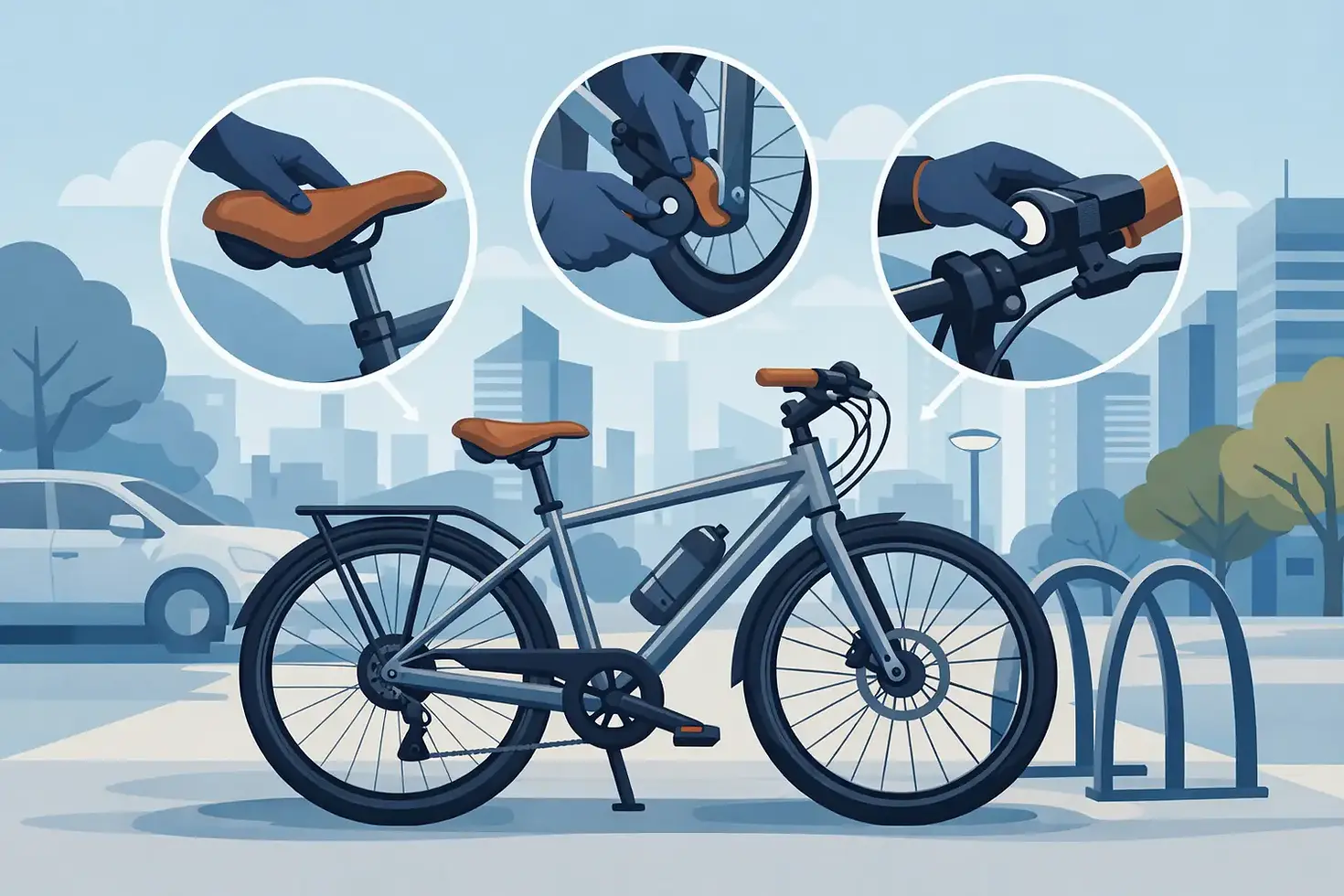
For most urban commuters, that means starting with the wheels and seat post. If your bike uses quick-release skewers, replace them with tamper-resistant locking skewers. If your saddle and seat post are valuable, use a dedicated seat post lock instead of relying on a standard clamp bolt. On bikes with premium cockpits or accessories, look at headset and component-specific hardware as well.
This is where generic security advice usually falls apart. It tells riders to "lock your bike in a visible area" and stops there. Visibility helps, but it does not secure a front axle. It does not keep a thief from lifting a saddle. It does not protect the parts shop owners and club riders actually care about replacing.
Secure the wheels first
If a thief can remove your wheel in under 10 seconds, that is your first fix. Wheel locks replace standard skewers or axle hardware with tamper-resistant systems designed to prevent casual tool access and quick removal at the rack.
A good wheel lock should do two things well. First, it should eliminate the convenience of a standard quick-release. Second, it should use a keyed or uniquely coded mechanism that is not defeated by the basic multi-tools many thieves carry. Pin tumbler designs and specially shaped lock interfaces matter here because they turn a simple grab into a failed attempt.
For commuters, securing both wheels is the right move, not just the front. Front wheels disappear more often, but rear wheels on higher-end bikes have real value, especially with disc brake setups, e-bike-compatible hubs, or upgraded wheelsets.
Then address the saddle and seat post
Seat post theft is common because many riders forget the clamp is the only thing holding that entire assembly in place. One quick release or one exposed bolt and the saddle plus post are gone.
A dedicated seat post lock replaces that weak point with tamper-resistant hardware. This matters even more if you run a carbon post, performance saddle, or any setup that costs enough to hurt when it disappears. For city bikes and commuter e-bikes, securing the seat post also reduces tampering and nuisance theft.
There is a trade-off. Standard quick release is convenient when multiple people share a bike or when fit changes often. But in daily city parking, convenience is exactly what thieves exploit. If the bike gets locked outside routinely, security should win.
Protect the parts riders forget
Headsets, stems, and accessories are less commonly discussed, but they are not theoretical. On bikes parked in the same place every day, repeat exposure gives thieves time to notice patterns and return with the right tool.
Component-specific locking hardware for the headset or cockpit can make sense if your bike carries expensive bars, integrated setups, or accessories that are hard to replace. Not every rider needs every lock, and that is the practical point. Match the hardware to the risk and value of the component.
A commuter with stock wheels and a low-cost saddle may only need wheel and seat post protection. A gravel bike with premium wheels, carbon parts, and a visible commuter routine needs more coverage.
Parking strategy still matters
Component locks work best when the parking choice is not doing the thief any favors. A bike left overnight on an isolated rack is under more pressure than one parked for 20 minutes in active foot traffic. Time and predictability change the risk.
Try not to park in the exact same exposed spot every day if you can avoid it. Repetition teaches thieves what bike is available and when. If your workplace offers indoor storage, badge-access parking, or monitored areas, use them. If you have to park curbside, choose racks with visibility from storefronts or passing pedestrian traffic.
But do not mistake visibility for protection. A busy block does not stop quick component theft unless the hardware itself slows the thief down enough to make the attempt unattractive.
What bike shops and clubs should recommend
For bike shops, component-level security is one of the easiest practical add-ons to explain because the theft vectors are obvious. Customers understand a stolen wheel immediately. The same goes for a missing saddle or seat post. A shop that sells commuter, road, gravel, and e-bike models should be offering per-component security at the point of sale, not after the customer comes back angry.
Clubs and associations have a different angle. Group rides, event parking, and travel all create moments when expensive bikes are left unattended for short periods. Members with high-end equipment often assume a short stop is low risk. That is exactly when quick component theft happens. Recommending locking skewers and seat post security is a practical policy, not a sales pitch.
What to look for in component locks
Not all hardware sold as security hardware is equally serious. Look for systems designed specifically for bicycle components, with tamper-resistant interfaces that cannot be removed by a standard hex key or quick-release lever. Pin tumbler mechanisms, coded keys, and per-component lock designs are what separate real theft deterrence from dressed-up bolts.
Fit also matters. The lock has to match your axle standard, frame spacing, and component dimensions. A poorly matched system creates installation problems or leaves gaps in coverage. That is especially true for e-bikes, through-axle setups, and newer road or gravel platforms where standards vary.
This is one reason riders and retailers use dedicated component security systems rather than improvising with generic hardware. The goal is clean fit, predictable operation, and enough resistance to make the thief move on.
A practical city setup that actually works
For most riders, the best real-world setup is simple. Use a high-quality primary lock for the frame and rear triangle. Add locking skewers or axle security to both wheels. Add a seat post lock if the saddle or post has value. If your bike has premium front-end components or gets parked for long stretches, secure the headset or cockpit hardware too.
That setup is stronger than relying on one heavy lock and hoping nobody notices the expensive parts attached to it. It also scales. A daily commuter can protect the common theft points without overcomplicating the bike. A higher-end road, gravel, or e-bike build can add full component coverage where it makes financial sense.
Pinhead is built around that idea - protect the entire bike, not just the frame. That means addressing the theft points thieves actually target in city parking, one component at a time.
If your current lockup leaves wheels, saddle, or seat post exposed, the fix is not more optimism. It is better hardware on the parts that disappear first.


Comments